Content Development: Meaning of some terms used in Energetics
- Energetics is the study of energy changes that occur during chemical reactions.
Chemical reactions involves energy changes because energy is required to break chemical bonds and energy is released when new bonds are formed.
- Exothermic Reactions is a chemical reaction in which heat is given off to the surrounding (environment).
Characteristics
- Temperature of the surroundings (container) increases (becomes hotter).
- The energy of the reactant is greater than that products.
- The energy liberated during bond making is more than that absorbed during bond breaking, hence the heat enthalpy change is negative.
Examples
- Combustion of fuels
- Neutralization reactions
- Respiration
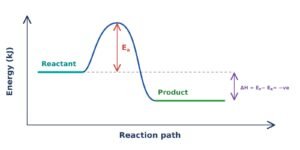
Energy Profile The energy level of the products is lower than that of the reactants. ΔH = EP – ER = -ve Ea = Activation Energy.
- Endothermic Reactions is a chemical reaction in which heat is absorbed from the environment (surrounding).
Characteristics
- Temperature of the surroundings (container) decreases (becomes cooler).
- The energy of the products is greater than that of the reactant.
- The energy absorbed during bond breaking is more than that liberated during bond making. Hence the enthalpy change is positive.
Examples
- Thermal decomposition
- Photosynthesis
- Some dissolving processes
Energy Profile The energy level of the products is higher than that of the reactants.
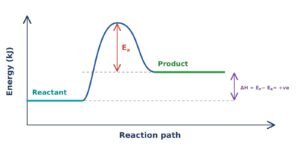
H = EP – ER = +ve Ea = Activation Energy