5. The Synapse
A microscopic gap between the axon terminal of one neuron and the next cell (dendrite, cell body, or muscle).
Electrical vs Chemical Synapses
|
Electrical Synapse |
Chemical Synapse |
|
Very rapid, no delay |
Slower (~0.5 ms delay) |
|
Passive; ions pass via gap junctions |
Active; needs neurotransmitter release |
|
Bidirectional |
Unidirectional |
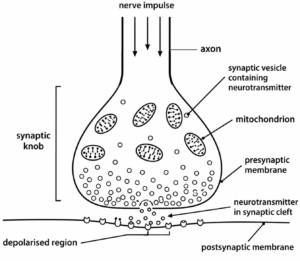
Structure of a chemical synapse (synaptic knob)
Synaptic Transmission
- Impulse arrives → voltage-gated Ca²⁺ channels open → Ca²⁺ enters synaptic knob → vesicles fuse with the presynaptic membrane → neurotransmitter (e.g. acetylcholine) released by exocytosis into the synaptic cleft.
- Neurotransmitter diffuses across, binds receptors on the postsynaptic membrane, opening Na⁺ channels → depolarisation (EPSP) generates a new impulse.
- Neurotransmitter is removed by enzyme breakdown (e.g. acetylcholinesterase), reuptake, or diffusion.
Excitatory vs Inhibitory Synapses
- EPSP (excitatory): net influx of cations → depolarisation → may trigger an impulse; can involve spatial summation (different neurons, same time) or temporal summation (same neuron, rapid succession).
- IPSP (inhibitory): efflux of cations / influx of Cl⁻ → hyperpolarisation → prevents an impulse.
Functions of the Synapse
- Ensures one-way transmission; filters out weak/background stimuli; allows summation; protects effectors from overstimulation.