6. The Central Nervous System (CNS)
Composed of the brain (in the cranial cavity) and spinal cord (in the vertebral column), both protected by three meninges — dura mater (outer), arachnoid mater (middle), pia mater (inner) — with CSF in the sub-arachnoid space (cushions, nourishes, and protects against infection).
The Brain — Forebrain, Midbrain, Hindbrain
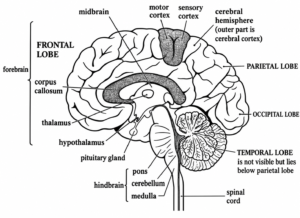
Longitudinal section through the mammalian brain
|
Region |
Structure |
Key Function(s) |
|
Forebrain |
Cerebrum (2 hemispheres, linked by corpus callosum) |
Conscious thought, memory, reasoning, language, interprets senses |
|
Forebrain |
Thalamus |
Relays sensory information (pain, pleasure) to the cerebrum |
|
Forebrain |
Hypothalamus |
Appetite, temperature, motivated behaviour; controls the pituitary; makes ADH & oxytocin |
|
Midbrain |
Reticular formation |
Links fore- and hindbrain; reflexes for sight/hearing |
|
Hindbrain |
Cerebellum |
Balance, coordination of movement, posture |
|
Hindbrain |
Medulla oblongata |
Heart rate, breathing, blood pressure — vital reflex centre |
|
Hindbrain |
Pons |
Bridges cerebellum and medulla; heart rate and breathing |
The Spinal Cord
- Inner grey matter (cell bodies/synapses) surrounds a central canal (CSF); outer white matter (myelinated tracts) carries impulses to/from the brain.
- Sensory neurons enter via the dorsal root (dorsal root ganglion, dorsal horn); motor neurons leave via the ventral root (ventral horn).
- Functions: relays information between brain and body; controls reflex actions below the neck.