- Experiments on Tropic Movements
Experiment 1 — Phototropism in Shoots
Aim: To demonstrate a shoot’s response to unidirectional light.
Requirements: Two potted bean seedlings (A and B), two cardboard boxes (each with a hole on one side), a klinostat.
- Procedure: Plant A is placed in a box so light reaches it from one direction only (test). Plant B is placed under similar conditions but on a slowly rotating klinostat, so all sides receive light equally (control). Left for three days, then examined.
- Result: Shoot A bent/grew towards the light; Shoot B grew straight upward.
- Explanation: Unidirectional light causes auxins to migrate to the darker (shaded) side of the shoot. The higher auxin concentration on the darker side makes it grow faster, so the shoot bends towards the light. In B, rotation gave uniform auxin distribution, so no bending occurred.
- Conclusion: Shoots are positively phototropic.
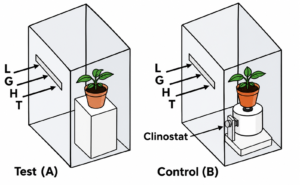
Set-up for the phototropism experiment: Test (A) vs Control (B) on a klinostat
Experiment 2 — Geotropism in Roots and Shoots
Aim: To show that roots respond positively to gravity while shoots respond negatively.
Requirements: Two potted bean seedlings, two cardboard boxes, a dark cupboard, a klinostat.
- Procedure: Seedling A is placed horizontally in a dark cupboard (test — gravity acts, light excluded). Seedling B is placed under similar conditions but on a rotating klinostat, cancelling gravity’s directional effect (control). Left for three days, then examined.
- Result: In A, the shoot grew upward (negatively geotropic) and the root grew downward (positively geotropic). In B, both shoot and root grew straight.
- Explanation: Gravity causes auxins to accumulate on the lower side of the organ. In roots, this high auxin concentration inhibits growth on the lower side, so the upper side grows faster and the root bends downward. In shoots, the higher auxin concentration on the lower side stimulates faster growth there, bending the shoot upward.
- Conclusion: Roots are positively geotropic; shoots are negatively geotropic.
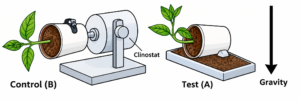
Set-up for the geotropism experiment: Control (B) on a klinostat vs Test (A)
Importance of Tropisms
- Enables shoots to grow towards sunlight for photosynthesis (chlorophyll production).
- Growing upward exposes flowers to pollinators (insects/wind) and exposes fruits/seeds to agents of dispersal.
- Positive geotropism/hydrotropism in roots ensures anchorage and access to water and minerals in the soil.