- Mechanism of Ventilation (Breathing)
Inspiration (active process, ~2 seconds at rest)
- External intercostal muscles contract (internal ones relax), pulling the rib cage up and out; the diaphragm contracts and flattens — thoracic volume increases, pressure drops, and air rushes in.
Expiration (passive, aided by elastic recoil)
- Internal intercostal muscles contract, pulling the rib cage in and down; the diaphragm relaxes back to its dome shape — thoracic volume decreases, pressure rises, and air is forced out.
|
Inspired Air |
Expired Air |
Reason |
|
More oxygen |
Less oxygen |
O₂ used in tissue respiration |
|
Less CO₂ |
More CO₂ |
CO₂ produced by respiration |
|
Cool, variable humidity |
Warm, more water |
Heat and water released by the body |
Control of Ventilation
- Nervous control: the medulla’s inspiratory centre (ventral) and expiratory centre (dorsal/lateral) link to the intercostal muscles (intercostal nerves), diaphragm (phrenic nerve) and bronchial tree (vagus nerve). Inflation stimulates stretch receptors, which trigger the expiratory centre to inhibit inspiration; deflation removes this inhibition, restarting inspiration.
- Chemical control: rising blood CO₂ stimulates chemoreceptors in the aortic arch and carotid arteries, which signal the inspiratory centre to increase the rate/depth of breathing (a 0.25% CO₂ rise can double ventilation rate). Breathing can also be controlled voluntarily (e.g. singing, holding breath).
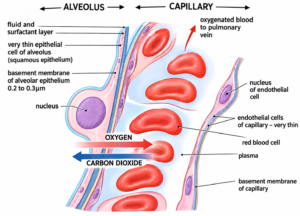
Gaseous exchange between an alveolus and a capillary