- Gaseous Exchange in Unicellular Organisms and Insects
- Amoeba: large surface area:volume ratio, moist permeable cell membrane; O₂ diffuses in and CO₂ diffuses out across the whole cell surface — no specialised system needed.
Insects — the Tracheal System
- Air enters through spiracles (openings with valves, hair-lined to reduce water loss) on the cuticle, controlled by CO₂ concentration — high CO₂ opens the spiracles (e.g. during flight).
- Spiracles lead to chitin-lined tracheae (support, impermeable to gas), which branch into fine tracheoles (no chitin, thin, moist, highly branched) in direct contact with tissues.
- During activity, lactic acid raises solute potential in tissues, drawing fluid out of the tracheoles by osmosis so air reaches the tissues directly — gaseous exchange is independent of the blood system.
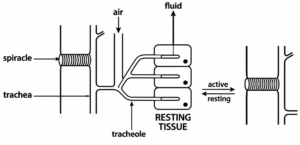
The tracheal system of insects: resting vs active tissue